
Strategy • Execution • Growth
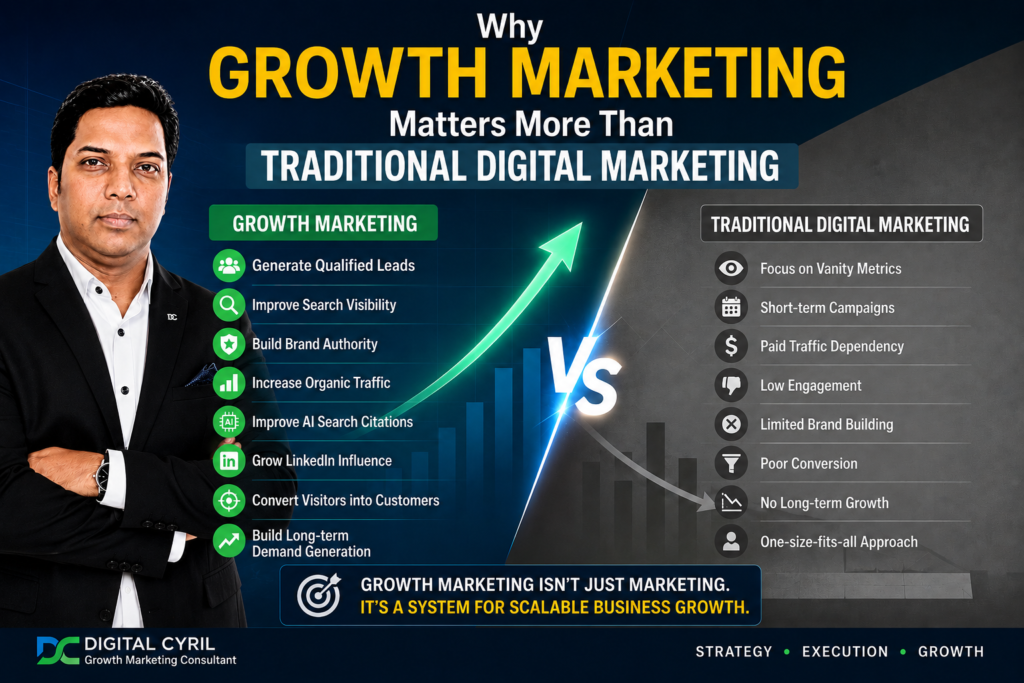
Why Growth Marketing Matters More Than Traditional Digital Marketing
Growth marketing is not just marketing. It is a measurable system for attracting the right audience, converting demand, improving customer retention and building sustainable business growth.
For businesses seeking more than impressions and clicks, the priority is to connect digital visibility with qualified leads, sales conversations and commercial outcomes.
Growth marketing is a data-informed, full-funnel approach that uses research, experimentation and measurement to improve how a business acquires, converts and retains customers. Traditional digital marketing often focuses on individual channels or campaign outputs. Growth marketing connects those channels to outcomes such as qualified enquiries, customer acquisition cost, conversion rate, retention and revenue.
The two approaches are not mutually exclusive. SEO, paid media, social media, email and content can all be part of a growth marketing programme. The difference is the operating model: growth marketing continually tests what works, identifies friction across the customer journey and scales activities that demonstrate meaningful business value.
Growth Marketing vs. Traditional Digital Marketing
| Area | Traditional channel-led approach | Growth marketing approach |
|---|---|---|
| Primary focus | Campaign activity, reach, clicks or channel performance | Customer journey and measurable business outcomes |
| Planning | Campaigns with periodic reviews | Prioritised hypotheses and continuous learning |
| Acquisition | Optimise channels independently | Coordinate channels around audience intent and lead quality |
| Conversion | Often evaluated after traffic arrives | Landing pages, offer, forms and follow-up are part of the system |
| Measurement | Impressions, clicks and engagement | Qualified leads, conversion, acquisition cost, retention and revenue |
| Long-term growth | May depend on repeated campaigns | Build repeatable learning, customer value and demand generation |
Key point: reach and engagement can be useful diagnostic metrics, but they do not automatically prove business impact. Connect them to qualified actions and downstream outcomes wherever measurement permits.
7 Components of an Effective Growth Marketing Strategy
Clear growth objectives
Define the outcome first: more qualified enquiries, a stronger sales pipeline, lower acquisition cost, higher conversion or improved customer retention. Record a baseline so progress can be assessed.
Audience and offer fit
Identify the best-fit customer, their problem, buying triggers, objections and decision process. Match the offer and message to that audience instead of pursuing broad, low-intent traffic.
Search and channel visibility
Combine relevant SEO, content, social, paid acquisition, partnerships and B2B outreach according to customer intent, competition, budget and sales cycle.
Conversion optimisation
Improve the landing-page message, proof, mobile experience, enquiry form and next step. Make it easy for a qualified prospect to understand the value and contact you.
Experimentation
Prioritise tests by likely impact, confidence, effort and time to learn. Document each change and evaluate results over a suitable period instead of relying on guesswork.
Measurement and attribution
Track qualified conversions, lead quality, sales progression and acquisition economics. Combine analytics with sales feedback because no attribution model captures every customer interaction perfectly.
Retention and referrals
Support onboarding, customer success, repeat business and appropriate referrals. Growth is stronger when a business delivers value after the first conversion.
Growth Marketing Channels That Can Generate Qualified Leads
There is no universally best channel. Choose the mix that reaches your actual buyers and measure the quality of the opportunities it produces.
- SEO services and organic search: Align service pages and useful content with high-intent searches, technical SEO, internal links and a clear conversion path.
- AI SEO and AI Search optimisation: Improve the clarity and usefulness of business information for search engines and AI-assisted discovery. AI mentions or citations are not guaranteed.
- Google Ads and paid acquisition: Reach relevant demand and evaluate qualified leads, conversion rate and acquisition cost—not clicks alone.
- LinkedIn marketing and B2B demand generation: Reach business decision-makers through useful expertise, targeted campaigns and consistent follow-up.
- Content marketing and thought leadership: Answer real buyer questions, demonstrate subject expertise and support evaluation before a sales conversation.
- Landing pages and conversion optimisation: Connect the campaign promise to the page content, evidence and a low-friction enquiry action.
- Email, CRM and retention: Nurture consented leads, support customers and maintain relevant communication through the buying journey.
How to Improve Conversion Rates and Lead Quality
- Match search intent: Make the page answer the question or need that brought the visitor there.
- Use a specific value proposition: Explain who you help, what problem you solve and what the prospect should do next.
- Show credible evidence: Use accurate experience, process details, case studies or testimonials only when they can be substantiated.
- Reduce friction: Keep forms focused, ensure the mobile layout works and make contact details easy to locate.
- Align marketing and sales: Define what counts as a qualified lead and establish a clear follow-up process.
- Test and document changes: Record the original state, change, measurement window and outcome. Avoid claiming causation from weak or incomplete data.
Growth Marketing Metrics: What Should You Measure?
| Metric | Why it matters |
|---|---|
| Qualified lead rate | Shows whether marketing attracts prospects who meet your agreed criteria. |
| Cost per qualified lead | Helps compare the cost of generating sales-relevant opportunities. |
| Landing-page conversion rate | Shows how effectively a page turns relevant visits into a defined action. |
| Lead-to-customer rate | Connects lead generation with sales outcomes. |
| Customer acquisition cost | Estimates the cost of acquiring a customer using a clearly defined method. |
| Organic impressions, clicks and qualified sessions | Shows whether search visibility is improving and attracting relevant visitors. |
| Retention, repeat purchase or renewal | Measures ongoing customer value where relevant to the business model. |
| Pipeline and revenue contribution | Connects marketing activity to commercial outcomes, while acknowledging attribution limits. |
Illustrative Example: From Website Traffic to Qualified Enquiries
This is a hypothetical example, not a verified client case study. Imagine a B2B services firm receiving website traffic but few qualified enquiries. Rather than immediately increasing ad spend, the team checks whether the traffic matches its target audience, whether the service page answers buyer questions, whether the enquiry form is easy to complete and whether sales follow-up is timely.
The team then tests a clearer value proposition, strengthens the page with genuine proof, simplifies the enquiry path and tracks qualified leads through the sales process. It continues only with changes that produce credible improvements over a suitable measurement period. If the number of enquiries increases but their quality declines, the team revisits targeting and messaging.
The takeaway is simple: growth marketing improves the whole path from discovery to customer value. More clicks alone are not proof of growth.
How SEO and AI Search Visibility Support Growth
SEO helps connect useful pages with people researching a problem, comparing solutions or searching for a provider. Strong foundations include crawlability, relevant content, search-intent alignment, clear internal links and useful service pages.
AI Search optimisation builds on these foundations by improving how clearly a business, its services and its expertise are represented in online content. It can support discoverability in AI-assisted search experiences, but no technique guarantees inclusion, rankings or citations in ChatGPT, Gemini, Perplexity or other systems.
Explore AI SEO consulting and the AI Search Optimization, AEO, GEO and LLM Visibility Guide for more on organic and AI-assisted discovery.
Want More Qualified Leads—not Just More Traffic?
Connect your positioning, search visibility, acquisition channels and conversion process to a clear commercial objective. Start by identifying the biggest constraint in your current growth funnel.
Growth Marketing for B2B, Startups and Hyderabad Businesses
The execution will differ by market. B2B and technology firms may prioritise account relevance, thought leadership and pipeline quality. Startups may focus on validating product-market fit and learning which acquisition loops are repeatable. Local businesses may prioritise high-intent local search, landing-page conversion and response speed. Real estate businesses may need location-specific intent, project information, qualified lead screening and disciplined follow-up.
Explore relevant services: Digital marketing and SEO consulting in Hyderabad, real estate marketing and sales, B2B lead generation consulting and personal branding strategy.
Frequently Asked Questions About Growth Marketing
What is growth marketing in simple terms?
Growth marketing is a measurable approach to attracting the right audience, converting prospects, retaining customers and improving business outcomes through testing and learning.
What is the difference between growth marketing and digital marketing?
Digital marketing uses online channels such as search, social media, email and paid advertising. Growth marketing can use those same channels but connects them through full-funnel experimentation and measurement, with a focus on qualified customers and sustainable outcomes.
How can growth marketing generate more qualified leads?
It aligns audience targeting, offer, content, landing pages, conversion tracking and sales follow-up. The goal is to improve the quality and commercial value of enquiries, not merely increase form submissions.
Which growth marketing channels are best for B2B companies?
The best mix depends on the buyer and sales cycle. SEO, thought leadership, LinkedIn, paid search, targeted content, email nurturing and partner referrals can all contribute when measured against qualified opportunities and pipeline progress.
How do you measure growth marketing ROI?
Use clearly defined measures such as qualified lead rate, cost per qualified lead, customer acquisition cost, lead-to-customer rate, retention and pipeline or revenue contribution. Document the attribution method and its limitations.
Can SEO and AI SEO improve organic visibility and leads?
SEO and AI Search optimisation can support discovery by improving technical accessibility, content relevance and clarity. Traffic and leads depend on search demand, competition, website quality, offer fit and conversion performance; AI citations cannot be guaranteed.
Who needs a growth marketing consultant in Hyderabad?
Startups, B2B firms, technology businesses, professional services and other organisations seeking a more measurable approach to acquisition, conversion, search visibility and retention may benefit from growth marketing consulting.
Build a More Measurable Growth System
Digital Cyril helps businesses assess growth opportunities across marketing strategy, SEO, AI Search visibility, lead generation and conversion. Start with your business objective and the bottleneck you need to solve.
Digital Cyril is a Hyderabad-based digital marketing and growth marketing consultant. Learn more about his background on the About Digital Cyril page.
Pingback: Branding and Growth Marketing for Startups in 2026 -