
AI SEO Consultant in Hyderabad | AI Search, GEO, AEO & LLM SEO
Digital Cyril is an AI SEO Consultant in Hyderabad helping startups, enterprises,
GCCs, B2B companies, professional services firms and real estate businesses improve
Google rankings, AI Search visibility, organic traffic, qualified leads, brand authority
and inbound enquiries.
The consulting practice combines
SEO, AI Search Optimization, Answer Engine Optimization (AEO),
Generative Engine Optimization (GEO), LLM SEO, entity optimization,
content strategy, internal linking, structured data and growth marketing.
The objective is to make your business, services, expertise, people and locations easier for
Google and AI-powered search systems to discover, understand, associate with relevant
search intent and potentially reference.
Digital Cyril combines 25+ years of corporate and consulting experience with an
85,000+ professional network through Happening Hyderabad to help businesses
strengthen search visibility, digital authority and commercial outcomes.
→ GET YOUR FREE AI VISIBILITY AUDIT
AI Search Visibility Audit
An AI Search Visibility Audit identifies where your business appears,
where competitors are visible, which commercial questions create opportunities and what
content or entity gaps may be limiting your visibility.
- Brand and entity visibility
- AI Search mentions and citations
- Competitor visibility
- Commercial keyword opportunities
- Search-intent gaps
- Content coverage gaps
- Internal-link opportunities
- Technical SEO opportunities
- Structured-data opportunities
- Conversion opportunities
Explore the Free AI Visibility Audit →
What Does an AI SEO Consultant Do?
An AI SEO Consultant combines conventional search engine optimization with
strategies designed for AI-powered discovery, answer engines and large-language-model-driven
search experiences.
The work focuses on the complete digital entity rather than a single keyword. It connects
business, people, services, locations, expertise, content, evidence and search intent
so the information architecture is clearer for both users and machines.
- Technical SEO and crawlability
- Keyword research and commercial search intent
- Keyword architecture
- Entity SEO
- Topical authority
- Semantic content
- Answer-focused content
- Structured data
- Internal linking
- AI Search visibility
- AI citation opportunities
- Competitor analysis
- Conversion-focused SEO
Want to Know Where Your Brand Appears in AI Search?
Identify your current AI visibility, competitor presence, citation opportunities and
high-intent search gaps before investing more in content or advertising.
AI Search Optimization Consultant in Hyderabad
As an AI Search Optimization Consultant in Hyderabad, Digital Cyril helps
businesses improve the connections between brand, expertise, service, location,
content, evidence and customer intent.
Businesses may use AI Search optimization to target high-intent searches such as:
- AI SEO Consultant Hyderabad
- AI SEO Expert Hyderabad
- AI Search Consultant Hyderabad
- AI Search Optimization Consultant Hyderabad
- AI Search Optimization Services
- AI SEO Services Hyderabad
- GEO Consultant Hyderabad
- AEO Consultant Hyderabad
- LLM SEO Consultant
- ChatGPT SEO Consultant
- AI Visibility Consultant
- AI Search Marketing Consultant
AI Search Optimization, AEO, GEO & LLM Visibility Guide →
AI SEO Services for Business Growth
AI SEO services should support both visibility and commercial outcomes.
Digital Cyril combines traditional SEO with AI Search optimization to help businesses
capture relevant demand, strengthen authority and improve qualified enquiries.
- AI SEO strategy
- AI Search Optimization
- Generative Engine Optimization
- Answer Engine Optimization
- LLM SEO
- AI citation optimization
- Entity optimization
- Topical authority
- Semantic content strategy
- Commercial keyword architecture
- Internal-link optimization
- Structured data and schema strategy
- AI visibility audits
- Competitor visibility analysis
- Conversion-focused search strategy
- AI-assisted lead generation strategy
For a broader digital acquisition strategy, see
Digital Marketing Consultant
.
AI Search Optimization for Google, ChatGPT, Gemini & Perplexity
AI Search Optimization helps businesses make their digital information easier
for search engines and AI systems to retrieve, interpret and associate with relevant questions.
- Google Search
- Google AI search experiences
- ChatGPT
- Google Gemini
- Microsoft Copilot
- Claude
- Perplexity
- Bing
The approach combines SEO, AEO, GEO, Entity SEO, structured data,
topical authority, semantic content, internal linking and AI-readable website architecture.
AI SEO, GEO & AEO Consulting →
Build Visibility Across Search and AI
Your website needs to be understandable not only to potential customers, but also to the
search and AI systems that increasingly mediate discovery.
What Is AI Search Optimization?
AI Search Optimization is the process of structuring a business’s website,
content, entities and supporting evidence so AI-powered search systems can better understand
the business and potentially reference it in generated answers.
It extends conventional SEO into conversational and generative search environments.
Key areas include:
- Crawlability
- Indexable content
- Search intent
- Entity relationships
- Factual consistency
- Structured data
- Topical authority
- Clear answers to high-intent questions
AI SEO, AEO, GEO & LLM SEO: What’s the Difference?
- SEO: focuses primarily on visibility in conventional search results.
- AEO: focuses on answer-oriented search and conversational information retrieval.
- GEO: focuses on visibility within generative search experiences.
- LLM SEO: focuses on making content, entities and relationships easier
for large language model systems to understand. - AI SEO: combines conventional SEO with strategies for AI-powered discovery.
These disciplines overlap, but they should not be treated as interchangeable labels.
A strong strategy connects them through search intent, entity architecture, useful content,
internal links and authority.
How Digital Cyril Improves AI Search Visibility
Digital Cyril improves AI Search visibility by making the business easier to identify,
understand, retrieve and associate with specific commercial questions.
- AI Search visibility audit
- Entity and content analysis
- Search-intent mapping
- Commercial keyword architecture
- Topical-authority development
- Internal-link optimization
- Structured-data optimization
- Answer-focused content
- External authority development
- Measurement and iteration
Useful measurements include AI citations, brand mentions, query coverage,
organic impressions, rankings, referral traffic and qualified enquiries.
Turn AI Search Visibility Into Commercial Opportunities
AI visibility becomes more valuable when it connects to relevant service pages,
strong calls to action and a clear path from discovery to enquiry.
SEO Consultant in Hyderabad
AI SEO still depends on strong conventional SEO foundations.
SEO consulting in Hyderabad can include:
- Technical SEO audits
- Keyword research and architecture
- Commercial search optimization
- Search-intent mapping
- Content clusters
- Internal linking
- Entity SEO
- Topical authority
- Schema and structured data
- Local SEO
- Enterprise SEO
- Conversion-focused SEO
- AI Search Optimization
Digital Marketing & SEO Consulting in Hyderabad →
AI Search Optimization for Hyderabad Businesses
Hyderabad businesses can use AI Search Optimization to improve discoverability
for local, commercial and industry-specific questions.
The strategy can connect business entities, services, locations, expertise and customer
intent across Hyderabad.
- Service + Hyderabad searches
- Business + Hyderabad searches
- Industry + Hyderabad searches
- Founder and executive searches
- Local commercial searches
- Location-specific searches
- High-intent lead-generation searches
Relevant Hyderabad markets can include Gachibowli, HITEC City, Madhapur,
Financial District, Kokapet and other major business locations.
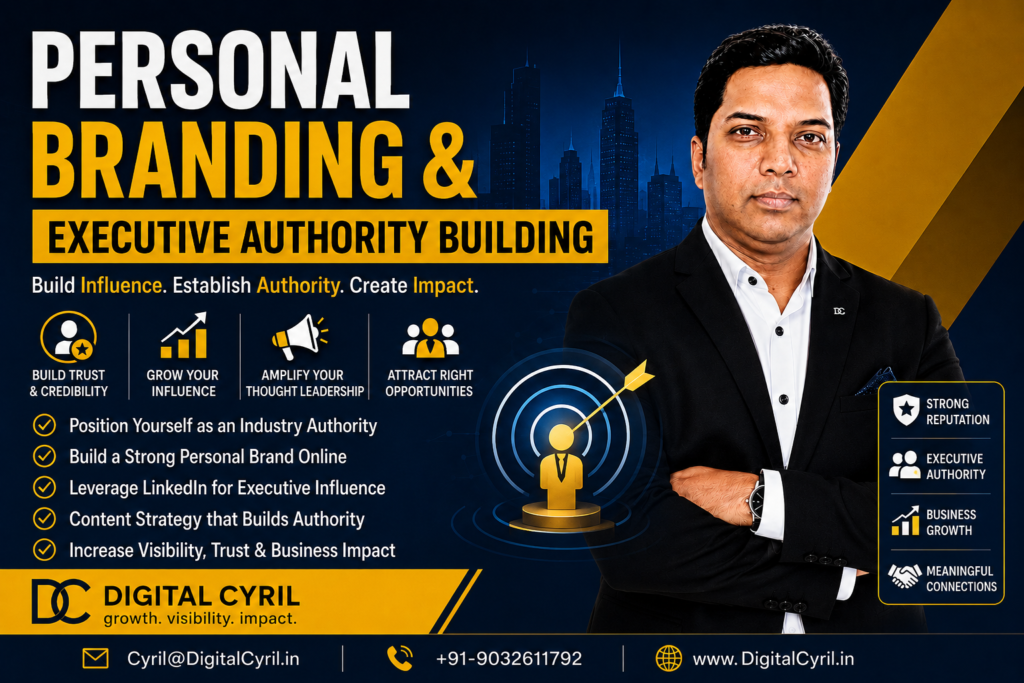
Personal Branding & LinkedIn Consultant in Hyderabad
Personal branding consulting helps founders, CEOs, CXOs, consultants
and business leaders strengthen digital authority and generate relevant inbound opportunities.
- LinkedIn profile positioning
- Founder branding
- Executive personal branding
- Thought leadership strategy
- LinkedIn content strategy
- Executive visibility
- Digital reputation
- AI Search visibility for personal brands
Personal Branding Consultant →
Build a Personal Brand That Gets Found
Connect your name, expertise, professional positioning, LinkedIn presence and website
into a stronger search and AI visibility system.
AI Search Optimization for Real Estate
Real estate brands can use AI Search Optimization to target property-related
searches before prospects reach a developer, broker or property portal.
- Real estate SEO
- Local SEO
- Property-location pages
- AI Search Optimization
- Project and location entities
- Property investment searches
- Google Business Profile optimization
- Conversion-focused landing pages
- Qualified property lead generation
Content can answer high-intent questions around property prices, locations,
projects, investment areas, connectivity, amenities and buyer requirements.
PCC Realty & Real Estate Marketing →
ChatGPT, Gemini, Perplexity & Google AI Visibility
Visibility across ChatGPT, Gemini, Perplexity and Google AI requires more than
adding keywords to a webpage.
AI systems may rely on multiple sources and search systems. Businesses therefore need:
- Clear entity information
- Crawlable pages
- Useful answers
- Topical depth
- Consistent facts
- Supporting authority
- Strong internal linking
- Relevant external references
The practical objective is to improve entity clarity, retrieval, relevance,
citation potential and consistency.
AI Search Visibility Audit for Businesses
An AI Search Visibility Audit identifies where a business appears,
where competitors appear, which questions produce visibility and what information may
be missing or inconsistent.
- Google Search visibility
- AI Overviews visibility where applicable
- ChatGPT visibility
- Gemini visibility
- Perplexity visibility
- Brand mentions
- AI citations
- Competitor visibility
- Content coverage
- Search intent
- Structured data
- Internal linking
- Crawlability
- Authority signals
Get a Free AI Visibility Audit →
Find Your AI Visibility Gaps
Discover which searches, entities, content topics and commercial pages deserve priority
before competitors capture more of the available demand.
AI Search Optimization Results & Measurement
AI Search Optimization should be measured through visibility, citations,
qualified traffic and business outcomes rather than a fixed ranking or conversion promise.
- AI-platform mentions
- Citation frequency
- Branded search impressions
- Organic impressions
- Keyword coverage
- Search rankings
- AI referral sessions
- Conversion rate
- Qualified-lead rate
- Cost per qualified lead
- Revenue attributed to organic or AI-assisted discovery
One external 2025 Seer/Wix dataset reported a 13.8% conversion rate for
AI-referred visitors versus 9.3% for organic visitors across its sampled clients.
That is a benchmark, not a forecast for an individual business.
B2B Lead Generation Consultant in Hyderabad
B2B lead generation combines organic search, AI Search, LinkedIn,
content, paid acquisition and conversion strategy to attract decision-makers rather than
generic website traffic.
- B2B SEO
- AI Search visibility
- LinkedIn lead generation
- Content-led demand generation
- Paid acquisition
- Conversion optimization
- B2B funnel strategy
- Outbound lead generation
- Cold email strategy consulting
B2B Lead Generation Consultant →
GCC Consultant in Hyderabad
Digital Cyril advises global companies establishing or expanding
Global Capability Centers in Hyderabad.
- GCC market entry
- Hyderabad location strategy
- Commercial office requirements
- GCC office-space research
- Leadership hiring
- Technology talent acquisition
- Workforce planning
- Recruitment partner strategy
- Employer branding
- Talent attraction
- Early-stage team building
Looking for Qualified B2B Leads or GCC Growth?
Connect search visibility, AI discovery, positioning and lead generation to the commercial
objective rather than treating each channel separately.
Who Digital Cyril Works With
- Startups
- Scale-ups
- SaaS companies
- Technology companies
- Global Capability Centers
- Real estate developers
- Hospitality brands
- Manufacturing companies
- Healthcare organizations
- Educational institutions
- Professional services firms
- Founders
- CEOs
- CXOs
Explore Digital Cyril’s Consulting Services
Digital Cyril Growth Marketing Consultant
Digital Marketing & SEO Consultant in Hyderabad
Digital Marketing Consultant
Digital Marketing, Branding & AI Search Strategist
AI SEO Consultant
AI Search Optimization, AEO, GEO & LLM Visibility Guide
AI Search Visibility Playbook
Free AI Visibility Audit
Personal Branding Consultant
Growth Marketing Consultant
B2B Lead Generation Consultant
Hyderabad GCC Consultant
Branding & Growth Marketing for Startups
Real Estate Marketing & PCC Realty
About Digital Cyril
Get a Digital Growth Roadmap for Your Business
If your challenge is Google rankings, AI Search visibility, qualified leads,
executive branding, GCC growth or real estate demand generation, start with
the commercial objective and the visibility problem you need to solve.
Talk to Digital Cyril on WhatsApp →
Ready to Turn Search Visibility Into Qualified Enquiries?
Get a practical assessment of your visibility across traditional search and AI-powered
discovery, then prioritize the opportunities most relevant to your business.
Why Work With Digital Cyril?
- 25+ years of corporate and consulting experience
- Founder of Happening Hyderabad
- 85,000+ professional network
- Direct senior-level consulting
- Digital marketing and SEO expertise
- AI Search, AEO and GEO expertise
- Growth marketing and B2B lead generation
- Executive personal branding
- GCC and real estate sector expertise
- Focus on qualified enquiries and commercial outcomes
About Digital Cyril
Digital Cyril Solomon is a Hyderabad-based
Digital Marketing Consultant, Growth Marketing Consultant,
AI Search Optimization Consultant, Personal Branding Strategist,
Brand Strategist and GCC Consultant.
Learn more about Digital Cyril’s experience and consulting background →
Digital Cyril AI Search & Marketing Resources
Digital Cyril is the author of the AI Visibility Playbook, covering
Generative Engine Optimization (GEO), Answer Engine Optimization (AEO) and strategies
for improving AI Search visibility.
AI Search Visibility Playbook
Hyderabad Luxury Real Estate & AI Search
Personal Branding Strategy
Branding & Growth Marketing for Startups
Frequently Asked Questions About AI SEO & AI Search Optimization
Q1. What does an AI SEO consultant in Hyderabad do?
An AI SEO consultant in Hyderabad combines technical SEO, keyword strategy,
content optimization, entity SEO, structured data, internal linking and AI Search Optimization
to improve organic visibility and the potential for AI-powered discovery.
Q2. What is an AI SEO consultant?
An AI SEO consultant combines traditional SEO with strategies for AI-powered
search and answer systems, including semantic content, entities, topical authority,
structured information, search intent and AI citation opportunities.
Q3. What is AI Search Optimization?
AI Search Optimization improves how a business, website, expert or brand can be
discovered, understood and associated with relevant questions by AI-powered search and answer systems.
Want to Improve Your AI Search Visibility?
Start with a visibility audit before committing to a larger AI SEO programme.
Q4. What is an AI Search Optimization Consultant in Hyderabad?
An AI Search Optimization Consultant in Hyderabad helps businesses improve
search and AI visibility by connecting business entities, services, locations, content,
expertise and supporting evidence through SEO, AEO, GEO and related optimization strategies.
Q5. What are AEO, GEO and LLM SEO?
AEO focuses on answer-oriented search experiences.
GEO focuses on visibility in generative search.
LLM SEO focuses on making content and entities easier for large language
model systems to interpret. These approaches can be combined with traditional SEO.
Q6. How can I get my business cited by ChatGPT?
There is no legitimate method that guarantees a ChatGPT citation. Businesses can improve
their potential visibility by strengthening entity clarity, useful content, topical authority,
factual consistency, internal linking, structured information and relevant supporting evidence.
Want Your Business to Be Easier for AI Systems to Understand?
Build stronger entity, content and authority signals around the services and questions
that matter most to your customers.
Q7. How can I improve my Google AI Search visibility?
Improving Google AI Search visibility starts with strong SEO foundations,
useful content, clear entities, topical authority, relevant answers, technical accessibility,
internal links and authoritative supporting information.
Q8. How can I improve AI search visibility for my business?
Start with an AI Search Visibility Audit, identify high-value commercial queries,
strengthen entity information, expand topical coverage, improve internal linking and create
content that clearly answers the questions your target audience asks.
Q9. What is an AI Search Visibility Audit?
An AI Search Visibility Audit reviews how a business appears across relevant
search and AI discovery environments, including brand mentions, citations, competitors,
content gaps, entity consistency, technical SEO and commercial visibility opportunities.
Q10. Can AI SEO increase website traffic?
AI SEO can contribute to website traffic by improving discoverability across
conventional search and AI-powered search experiences. Actual results depend on search demand,
competition, content quality, technical SEO, indexing and audience behaviour.
Need More Organic Traffic and Qualified Leads?
Connect AI Search with conventional SEO, content, lead generation and conversion strategy.
Q11. Can AI Search Optimization generate more leads?
Yes. AI Search Optimization can support lead generation when high-intent
searches connect to useful commercial pages, compelling calls to action and a clear conversion path.
Business results depend on the market, offer, competition and website conversion performance.
Q12. What is the best AI SEO strategy for a B2B company?
A strong B2B AI SEO strategy combines commercial keyword research, technical SEO,
topical authority, thought leadership, entity optimization, AI Search visibility, LinkedIn content
and conversion-focused landing pages.
Q13. What is the best AI SEO strategy for real estate?
A strong AI SEO strategy for real estate connects property locations, projects,
prices, investment questions, connectivity, amenities and buyer requirements with useful content,
local SEO, structured information, internal links and conversion-focused property pages.
Q14. Can AI Search Optimization help Hyderabad GCCs?
Yes. AI Search Optimization for Hyderabad GCCs can target searches around
GCC consulting, market entry, office locations, technology talent, hiring, leadership recruitment,
workforce planning and GCC expansion.
Q15. How long does AI Search Optimization take?
There is no universal timeline. Results depend on website authority, technical health,
indexing, competition, content depth, entity clarity and supporting evidence.
Early progress can be measured through content coverage, rankings, impressions and
AI visibility testing, while sustained gains generally require continued optimization.
Need an AI SEO Strategy for Your Industry?
Digital Cyril works across B2B, technology, startups, real estate, GCCs,
professional services and personal brands.
Q16. What does an AI SEO audit include?
An AI SEO audit can include technical SEO, crawlability, indexability,
keyword architecture, search intent, content quality, topical authority, entity optimization,
structured data, internal linking, competitor analysis and AI Search visibility.
Q17. What is the difference between an AI SEO consultant and an AI SEO agency?
An AI SEO consultant generally focuses on strategic diagnosis, prioritization,
architecture and specialist advice, while an agency may provide a larger execution team.
The right model depends on the level of strategy and implementation required.
Q18. How do you measure AI Search visibility?
AI Search visibility can be measured through AI mentions, citations,
competitor comparisons, query coverage, organic impressions, rankings,
AI referral traffic, qualified enquiries, conversion rate and revenue contribution.
Q19. Can AI SEO replace traditional SEO?
No. AI SEO should complement traditional SEO.
Crawlability, indexing, technical quality, useful content, search intent,
internal linking and authority remain important foundations for conventional
and AI-powered search.
Q20. Can Digital Cyril optimize a personal brand for AI Search?
Yes. Personal-brand AI Search Optimization can connect a person’s name,
expertise, location, professional experience, publications, services and supporting evidence
across their website, LinkedIn and relevant external sources to make the professional entity
easier for search and AI systems to understand consistently.
Ready to Improve Your AI Search Visibility?
Whether you need an AI SEO Consultant in Hyderabad, AI Search Optimization Consultant,
SEO Consultant, GEO Consultant, AEO Consultant, Growth Marketing Consultant,
Personal Branding Strategist, B2B Lead Generation Consultant or GCC Advisor,
start with the business objective and the search visibility problem you need to solve.
Pingback: Branding and Growth Marketing for Startups in 2026 -